Oregon Agriculture in the Classroom Logo

Featured Resources

Categories

Type

Grade Level

  • The Story of SeedsLogin to Hold

    Total Available: 2 (of )

    Must be returned

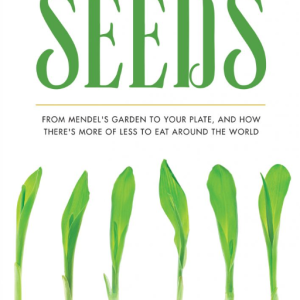
    The Story of Seeds

    Nancy Castaldo

    Something as small as a seed can have a worldwide impact. Did you know there are top-secret seed vaults hidden throughout the world? And once a seed disappears, that’s it—it’s gone forever? With the growth of genetically modified foods, the use of many seeds is dwindling—of 80,000 edible plants, only about 150 are being cultivated. With a global cast of men and women, scientists and laypeople, and photographic documentation, Nancy Castaldo chronicles where our food comes from, and more importantly, where it is going as she digs deeper into the importance of seeds in our world. This empowering book also calls young adult readers to action with suggestions as to how they can preserve the variety of one of our most valuable food sources through simple everyday actions. This book must be returned.
  • Discover Agriculture Careers Card SetLogin to Hold

    Total Available: 6 (of )

    Must be returned

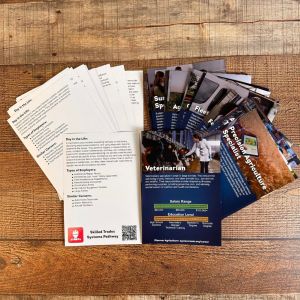
    Discover Agriculture Careers Card Set

    Wondering what job titles are out there, what they involve, where they’re located, and how much they pay? Interested in the education and experience needed to land them? This 48-card career set is a great way to explore the possibilities, get inspired, and start planning a future in agriculture! This product must be returned.

    These career cards pair great with the Discover Agriculture Careers Lesson. Check out the lessons by clicking on the links below:

    Grades 6-8: Discover Agriculture Careers: One Problem at a Time (Grades 6-8) – Curriculum Matrix | Oregon Agriculture in the Classroom Foundation

    Grades 9-12: Discover Agriculture Careers: One Problem at a Time (Grades 9-12) – Curriculum Matrix | Oregon Agriculture in the Classroom Foundation

  • Gardening with Less WaterLogin to Hold

    Total Available: 1 (of )

    Must be returned

    Gardening with Less Water

    David A. Bainbridge

    Gardening with Less Water offers simple, inexpensive, low-tech techniques for watering your garden much more efficiently — using up to 90 percent less water for the same results. With illustrated step-by-step instructions, David Bainbridge shows you how to install buried clay pots and pipes, wicking systems, and other porous containers that deliver water directly to a plant’s roots with little to no evaporation. These systems are available at hardware stores and garden centers; are easy to set up and use; and work for garden beds, container gardens, and trees.This book would be an excellent resource for 6th-12th grade educators looking to provide water conservation engineering challenges for their students.This book must be returned.
  • Oregon Cherries & Honey Bees PosterLogin to Hold

    Total Available: 19 (of 40)

    Does not need to be returned

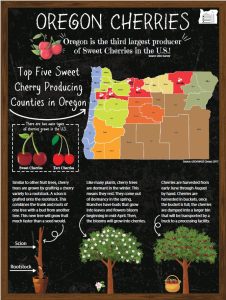
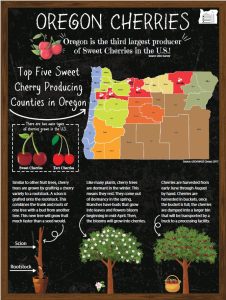
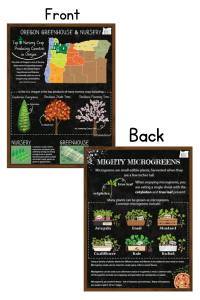
    Oregon Cherries & Honey Bees Poster

    This 2-sided 18x24" poster features Oregon's cherry industry and the life cycle of Honey bees. A great additional to celebrate the upcoming Spring season.
  • Grown in Washington County Map

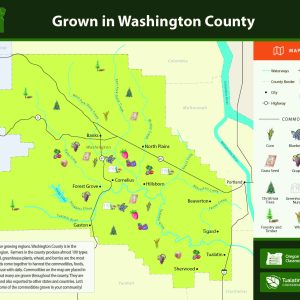
    This beautiful 8.5 x 11 inch full color map of Washington County features unique commodities grown in the county. It is an excellent tool to bring a piece of the story one County plays in Oregon’s agricultural diversity to the classroom.The Grown in Washington County Map helps students visualize where things are grown right in their backyard. On the back of the map student's can learn some more information about the unique commodities grown in the County and how they support the diversity of Oregon agriculture.Maps are free to Oregon teachers. If you would like a classroom set please let us know how many to send!
  • 101 Common MossesLogin to Hold

    Total Available: 3 (of 5)

    Must be returned

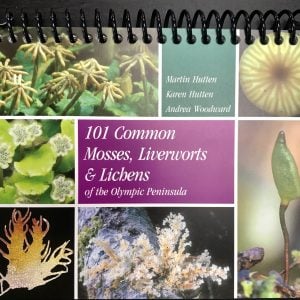
    101 Common Mosses, Liverworts & Lichens of the Olympic Peninsula

    Martin Hutten, Karen Hutten, Andrea Woodward

    This fun field guide will help students learn about the many different types of mosses, liverworts and lichens! The descriptions are very user friendly and include up-close pictures of each different plant form with details on their purpose and where they can be found. This item will need to be returned.
  • A Guide to Oregon's Forest WildlifeLogin to Hold

    Total Available: 1 (of 2)

    Must be returned

    A Guide to Oregon’s Forest Wildlife

    Oregon Forest Resources Institute

    Why so the different animals in Oregon's forests choose to live where they do? This booklet describes some of the wildlife associated with stands of different age classes.
  • A Guide to Priority Plant and Animal Species In Oregon ForestsLogin to Hold

    Total Available: 1 (of 5)

    Must be returned

    A Guide to Priority Plant and Animal Species In Oregon Forests

    Oregon Forest Resources Institute

    This revised and updated publication is designed to assist forest landowners, land managers, students, and educators in understanding how forests provide habitat for different wildlife and plant species. It describes the specific habitat requirements of selected species found in forested habitats across all ecoregions in Oregon. It provides teachers and students a way to learn more about wildlife species and the forest habitats they use and helps landowners and land managers determine what species to include in their management plans.
  • The Organic Artist for KidsLogin to Hold

    Total Available: 1 (of )

    Must be returned

    The Organic Artist for Kids

    Nick Neddo

    The Organic Artist for Kids inspires creativity by connecting kids and their adults to our wilderness roots. This book offers a wide variety of fun, collaborative projects using nature as a source for art supplies and inspiration, and also introduces the concepts of awareness and perception that are fundamental to the creative process. Children will be encouraged to learn new skills, build resilience, and be resourceful as part of an urgent struggle to prevent and undo Nature Deficit Disorder. Rooted in experimentation and an understanding that fun is fundamental to learning, kids will refine their drawing skills, as well as increase their appreciation for the visual arts and the natural landscape. Book must be returned.
  • Where Should Development Go? Portland Metro AreaLogin to Hold

    Total Available: 8 (of 4)

    Does not need to be returned

    Where Should Development Go? Portland Metro Area

    Students learn about the challenges of planning for development while still protecting important farmland, forestland and wildlife habitat. This two-part lesson allows students to brainstorm creative solutions using critical thinking, math, teamwork and problem solving skills.This lesson includes six topography maps, a lesson and corresponding activity that has has colored blocks to complete it with. This item does not need to be returnedDownload LessonDownload Activity
  • Bon Appetit: The Delicious Life of Julia ChildLogin to Hold

    Total Available: 2 (of 2)

    Must be returned

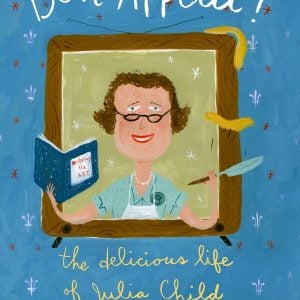
    Bon Appetit: The Delicious Life of Julia Child

    Jessie Hartland

    Follow Julia Child—chef, author, and television personality—from her childhood in Pasadena, California, to her life as a spy in WWII, to the cooking classes she took in Paris, to the publication of Mastering the Art of French Cooking, to the funny moments of being a chef on TV. Use this book to teach about the diversity of careers available in the food system!
  • Careers in ConservationLogin to Hold

    Total Available: 5 (of 100)

    Does not need to be returned

    Careers in Conservation

    United States Department of Agriculture

    This brochure engages readers in the foundation and mission of Natural Resources Conservation Services as well as career opportunities and how to get involved.
  • Cotton Boll

    These cotton bolls are a great way to show students how cotton grows. Feel free to tear it apart and inspect, no need to return! Pairs well with King Cotton Lesson.
  • Voices from the Field: Children of Migrant Farmworkers Tell Their StoriesLogin to Hold

    Total Available: 2 (of 2)

    Must be returned

    Voices from the Field: Children of Migrant Farmworkers Tell Their Stories

    S. Beth Akin

    This critically acclaimed book features photographs, poems, and interviews with nine children who reveal the hardships and hopes of today's Mexican-American migrant farm workers and their families.
  • Cycling Back to Nature: Food Production and PesticidesLogin to Hold

    Total Available: 3 (of 5)

    Must be returned

    Cycling Back to Nature: Food Production and Pesticides

    Robert Horton

    This instructional unit is versatile and can be adapted to various grade levels. The guide contains information and lesson plans about the ecosystem, microorganisms, farmer role-playing, pesticides, and the environment, and world populations and food production. Well written and teacher friendly. These materials would be very useful in 5th grade science and economics education for grades 4-9.
  • Cycling Back to Nature: Soils Alive! — From Tiny Rocks to CompostLogin to Hold

    Total Available: 5 (of 11)

    Must be returned

    Cycling Back to Nature: Soils Alive! — From Tiny Rocks to Compost

    Robert Horton

    This hands-on guide explores Mother Nature's development of soil and soil enhancements through composting.